

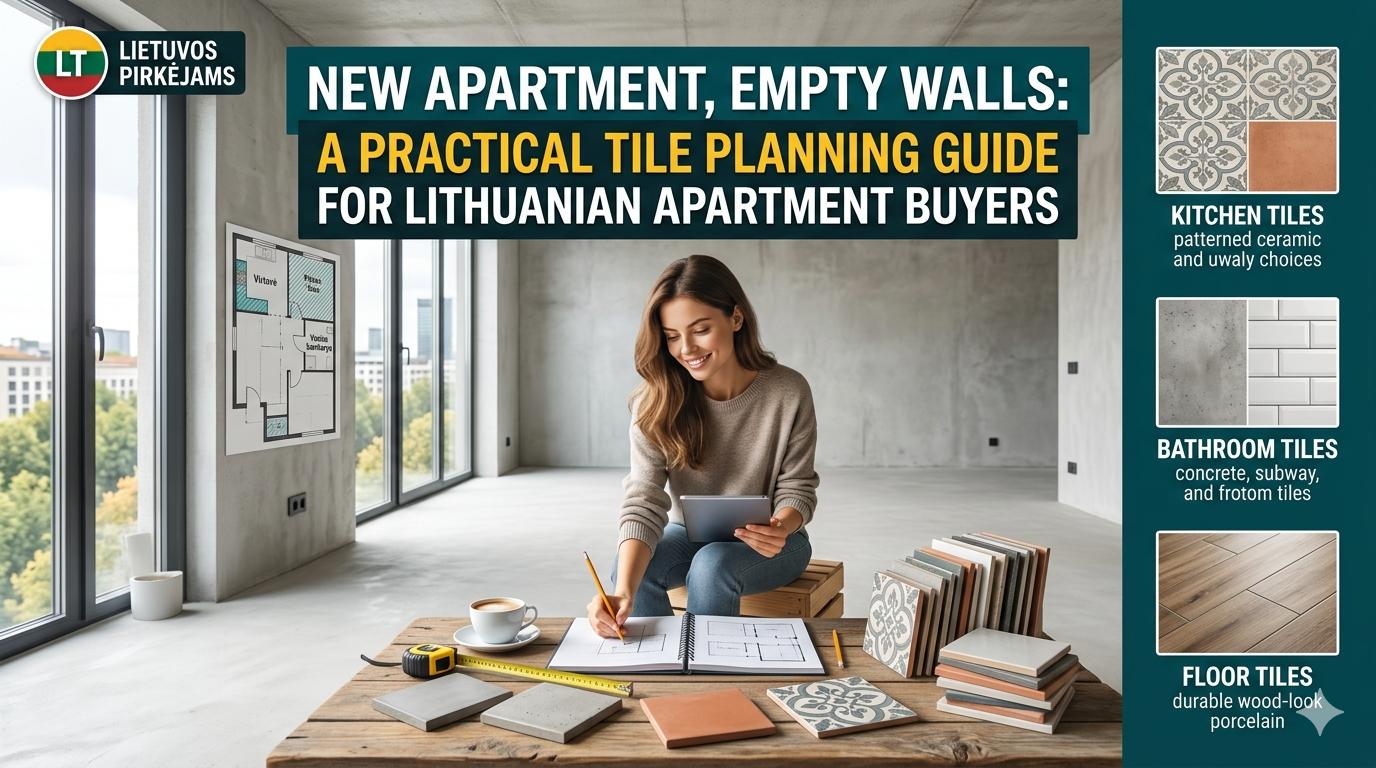
You finally have the keys.
After months of negotiations, paperwork, and waiting, you’re standing in your brand-new apartment staring at bare concrete floors and raw walls. The developer handed you the shell. Everything else is yours to figure out.
For most new apartment owners in Lithuania, this moment arrives with a wave of excitement — followed almost immediately by paralysis. There are a hundred decisions to make and no clear starting point. Paint colours, furniture, lighting, storage — it feels like it all needs to happen at once.
Here’s what experienced renovators will tell you: tiles are the first decision, not the last. Everything else — wall colours, cabinetry finishes, light fixtures — gets chosen around your tiles. Get the tiles right, and the rest of the interior almost arranges itself. Get them wrong, and you’ll be living with the mistake for a decade or more.
This guide walks you through everything you need to plan your tile project correctly — before you spend a cent or call a single contractor.
Why Tiles Are the Foundation of Every Interior Decision
Tiles are the most permanent element in any renovation. Unlike paint you can change in a weekend or furniture you can swap in an afternoon, tiles are set in place with adhesive and grout — replacing them means jackhammers, dust, cost, and a week of disruption.
That permanence is exactly why professionals always start with tile selection. Once you’ve chosen your bathroom floor tile, it anchors the colour palette for your walls, the tone for your fixtures, and the mood for the entire room. A cool grey large-format stone tile demands a different lighting approach than warm terracotta. A polished white XXL slab opens a small bathroom in a way that 20×20 cm metro tiles never can.
Think of tiles as the permanent canvas. Everything else is decoration.
Understanding Tile Formats: Small, Large, and XXL
Lithuanian apartment buyers often default to mid-size tiles because they’re familiar — you’ve seen them in every bathroom since childhood. But format choice has evolved significantly in recent years, and it’s worth understanding what’s available before committing.
Small format tiles (up to 30×30 cm) These work well in intricate patterns, shower floors with slip-resistance requirements, and properties with irregular or curved walls. They’re easier for amateur installers to cut and adjust. The downside: many grout lines, more maintenance, and a fragmented visual effect that can make small rooms feel even smaller.
Large format tiles (60×60 cm to 80×80 cm) The modern standard for most residential applications. Fewer grout lines mean easier cleaning and a cleaner visual. They work well in bathrooms, kitchens, hallways, and living spaces. Most professional contractors are fully equipped to handle these.
XXL format tiles (120×60 cm and larger, up to 320×160 cm) This is where interior results get genuinely striking. XXL tiles can turn a standard 6-square-metre bathroom into something that looks three times its size. They’re increasingly popular in premium apartments, luxury renovations, and properties intended for the rental or resale market. However, they require specialist equipment for precision cutting and experienced installers who understand the specific adhesive and levelling requirements for large slabs. Not every contractor handles them — and the ones who don’t will often tell you they do.
If you’re looking at premium results, XXL format is worth budgeting for.
Room-by-Room Tile Planning
Each room in your apartment has different traffic patterns, moisture exposure, and visual requirements. Here’s how to approach each:
Bathroom This is your highest-priority room. It’s the one most visible to guests, most affected by moisture, and most directly tied to your property’s perceived value. Prioritise slip-resistance for floors (especially wet zones and shower trays), and water-resistance for walls. For a bathroom under 8 square metres, XXL format floor tiles dramatically expand the visual space. Grout colour matters enormously — dark grout shows stains less but darkens the room; white grout is bright but high-maintenance.
Kitchen Focus on the splashback area behind the hob and sink, plus the floor. Kitchen floors see heavy foot traffic and cooking-related spills — choose tiles with a matt or satin finish that hides watermarks. Large format tiles work particularly well for continuous kitchen floors running into open-plan living areas, creating a sense of flow.
Hallway and Entrance High traffic means durability comes first. Choose tiles with a hardness rating of PEI 4 or 5. Many homeowners underestimate the hallway — but it’s the first space guests see and sets the tone for the entire apartment. A continuous tile from hallway into living area makes smaller apartments read as larger.
Living Room An increasingly popular choice as tiles improve in warmth and texture. Large concrete-look or stone-look tiles can create a sophisticated, low-maintenance alternative to wood flooring. Consider underfloor heating compatibility early — not all tile adhesives and thicknesses work with all heating systems.
What to Decide Before Calling a Contractor
Many apartment owners make the mistake of calling contractors before making key decisions. This leads to vague quotes, misaligned expectations, and budget surprises. Before your first consultation, know:
- Your approximate budget per square metre — including tiles, adhesive, grout, labour, and waste factor (typically add 10–15% for cuts and breakage)
- Which rooms you’re tiling and in what sequence — bathrooms first is standard; doing everything simultaneously reduces labour costs but requires more coordination
- Your format preference — at least whether you’re open to XXL or keeping to standard large format
- Your timeline — new apartments in Lithuania often have a finishing window before furniture delivery deadlines; contractors need lead time
Researching Materials Without Drowning in Spam
The research phase is where most apartment buyers spend weeks browsing tile showrooms, manufacturer websites, and online catalogues. This is also where your primary email inbox starts to suffer.
Tile suppliers, flooring companies, and renovation material brands all run aggressive email marketing campaigns. If you’re requesting quotes, downloading catalogues, or signing up to access pricing pages, your inbox will be flooded within days. Many people find that using a temporary email address for non-critical registrations during the research phase keeps their main inbox clean and focused — saving them from weeks of promotional newsletters once they’ve already made their decision.
Once you’ve narrowed down your shortlist and are ready for serious contractor conversations, you can switch to your real contact details for follow-up communication.
Realistic Budgeting for Lithuanian Apartment Tile Work
Tile budgets in Lithuania vary widely depending on format, material, and scope. Here’s a rough framework:
- Economy bathroom (5–8 m²): €800–1,500 including materials and labour
- Mid-range bathroom with large format tiles: €1,500–2,500
- Premium bathroom with XXL slabs and designer fittings: €3,000–5,000+
- Kitchen floor and splashback: €600–1,500 depending on area
- Full apartment (hallway, kitchen, bathrooms): €3,000–8,000 depending on total area and specifications
The most common budget mistake is under-estimating the cost of premium labour for XXL tiles. Cutting a 120×60 cm rectified slab requires specialist equipment. Laying it without lippage (uneven edges between tiles) requires experience. Hiring a general handyman to save €200 on labour and ending up with poorly laid XXL tiles is a cost that compounds — you’ll either live with imperfect results or pay twice to have it redone.
What to Look for in a Tile Contractor
When comparing quotes, price is one factor — but experience with your chosen format is the more important question. For standard large-format work, most professional tile contractors will deliver good results. For XXL format installations, ask specifically:
- Do you have your own cutting equipment for XXL slabs?
- Can you show examples of previous XXL projects?
- What adhesive and levelling system do you use for large formats?
- How do you handle the waste calculation and ordering process?
A contractor who can answer these questions fluently and show a portfolio of completed XXL work is worth a higher quote than a cheaper generalist who handles all formats the same way.
Starting Fresh vs. Starting a Renovation Business
One last note: many apartment owners who go through a first successful renovation discover a real interest in the process. If you find yourself planning a second property — or thinking about offering renovation consulting or interior design services — the first practical challenge is establishing your professional brand. An AI name generator is a surprisingly fast way to brainstorm business name ideas when you’re ready to move from client to service provider.
But first — get your own apartment finished beautifully.