

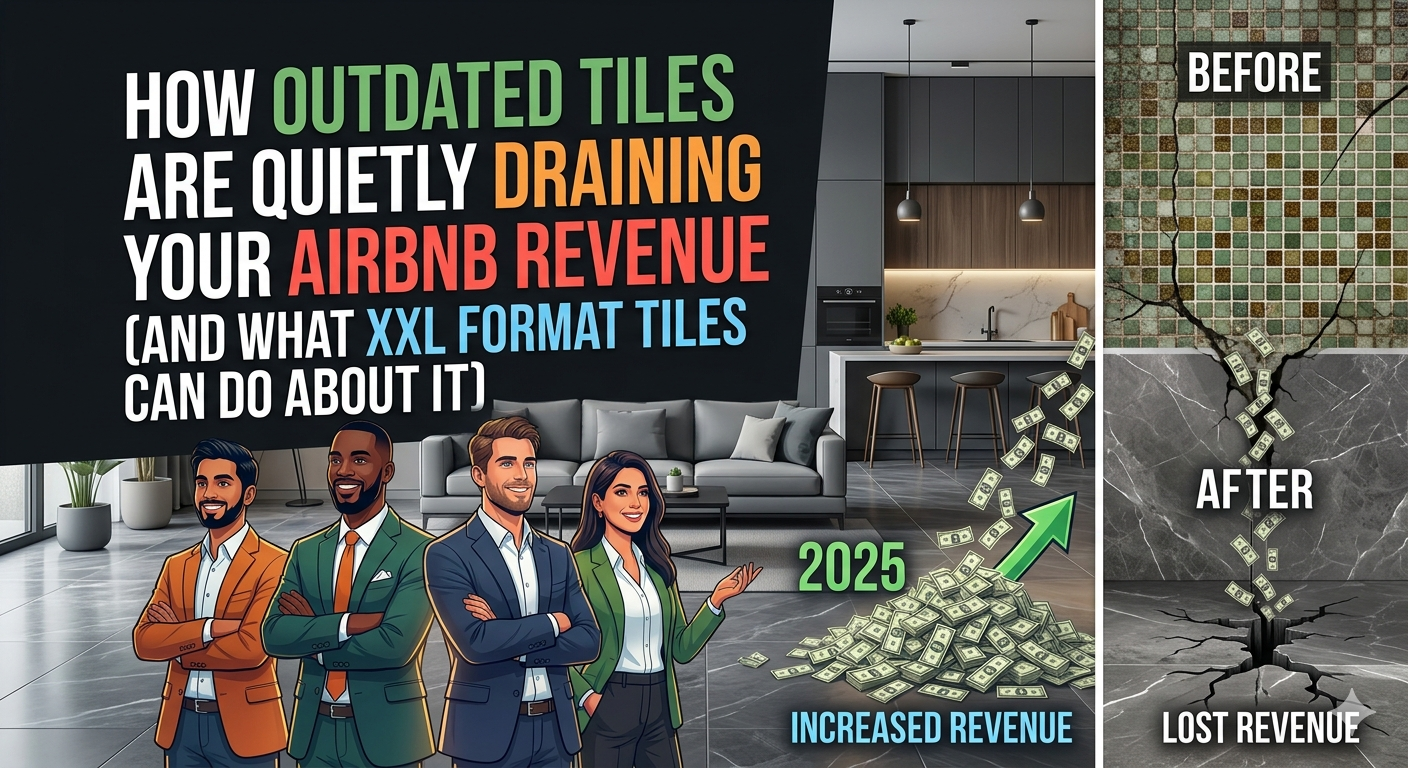
You can price your Vilnius apartment competitively. You can write a polished listing description. You can respond to guest enquiries within minutes.
But if your bathroom tiles are cracked, yellowed, or simply look like 2003, none of it will save your star rating.
In the short-term rental market, guest perception is everything — and perception forms in seconds. Before a guest reads a single word of your listing, they’ve already decided how they feel about the apartment based on the hero photo. And in most Vilnius apartments, that hero photo includes the bathroom.
This article is about a specific, frequently overlooked problem that Airbnb hosts and property owners preparing for sale face in Lithuania: the tile gap. And it’s about why solving it intelligently — not expensively — produces returns that outperform almost any other renovation investment.
The Star Rating Problem Nobody Talks About
Look at your recent guest reviews. Now look for indirect mentions of the bathroom — „clean but a bit dated,” „functional,” „not what the photos suggested,” „felt a bit old.” These are polite codes for one specific complaint: the tiles.
Guests rarely write „the tiles were ugly.” They write around it. But the impact on your star rating is real and measurable.
A Vilnius short-term rental averaging €70/night with a 4.3-star rating sits in a different algorithmic tier than the same apartment at 4.7 stars. The difference in booking frequency and nightly rate that results from that half-star gap often amounts to €3,000–5,000 per year — sometimes more in central city locations.
The tile problem is also generational. Apartments built or last renovated in the 1990s and early 2000s have tiles that made sense at the time: small format, often beige or terracotta, with heavy grout lines that collect grime even after cleaning. To guests under 45 — which describes the majority of short-term rental users — these tiles read as neglected, regardless of how thoroughly the apartment was cleaned before their arrival.
Why Tiles Hit Harder Than Other Renovation Choices
Consider the options a property owner has when investing in renovation. New furniture is visible in photos but doesn’t significantly change the room’s architecture. Fresh paint improves brightness but doesn’t transform the perceived quality of the space. Better lighting helps, but it’s a supporting element.
Tiles are different because they change the fundamental character of a room. They’re the floor and the walls — the largest surface area in your bathroom. When they change, the room changes completely.
There’s also a trust signal dimension. Guests are paying for accommodation, not a hostel. When tiles are clean, modern, and well-maintained, they signal that the property owner takes care of their investment. That signal translates directly into reviews, repeat bookings, and willingness to accept a higher nightly rate.
The XXL Advantage for Rental Properties
Among renovation professionals, there’s a growing consensus that XXL format tiles — slabs of 120×60 cm or larger — deliver a disproportionate visual return for rental properties specifically.
Here’s why:
The small bathroom problem. Most Vilnius apartments have bathrooms under 8 square metres. Standard tiles with multiple grout lines segment the floor and wall surfaces visually, making the space feel fragmented and smaller. A continuous XXL tile with minimal grout lines creates an unbroken visual field that makes the same 6-square-metre bathroom feel significantly larger. This matters in photographs — which is where your booking decision gets made.
The cleaning signal. Fewer grout lines means fewer places where grime accumulates. Professional cleaning between guest stays becomes more effective, and photos taken after cleaning look genuinely spotless rather than freshly-wiped-but-still-grey-at-the-grout. This shows up in reviews.
The premium positioning. XXL format tiles are a visual cue associated with recent, high-budget renovation. Guests who see them in photos associate the property with a higher tier of accommodation, which supports higher pricing and attracts more discerning guests who tend to leave better reviews.
The investment cost for a bathroom tile upgrade using XXL slabs in Vilnius is typically in the range of €1,500–3,000 depending on the size of the space and specification of tiles chosen. For a property doing €2,000/month in Airbnb revenue, this investment pays for itself in less than two months — not from increased volume alone, but from the compounding effect of improved ratings on long-term visibility and pricing power.
Pre-Sale: When Tiles Become a Negotiating Lever
The same principle applies to apartments being prepared for sale. Buyers make emotional decisions supported by rational justifications. A well-tiled bathroom removes one of the most common objections — „I’d have to redo the bathroom” — before the buyer has a chance to voice it.
Real estate agents across Vilnius consistently note that dated tile work in bathrooms and kitchens is one of the most common reasons sellers fail to achieve asking price, or sit on the market longer than expected. The calculation is stark: a €1,500–2,000 tile refresh investment frequently translates to a €5,000–10,000 increase in final sale price, simply by removing the objection before it forms.
For apartments in the €150,000–250,000 range — which covers a substantial portion of the Vilnius secondary market — this is among the highest-ROI pre-sale investments available.
Planning a Renovation Around Your Booking Calendar
For active rental properties, the logistics of renovation require planning. The good news: a single bathroom tile renovation by an experienced team typically takes 3–5 working days. For a kitchen floor and splashback, add 1–2 days. Full bathroom-plus-kitchen projects in standard apartment configurations are often completable within a week.
The practical approach for hosts:
Block a low-season window. January and February are traditionally the slowest months for short-term rentals in Vilnius. A renovation in this window loses the least revenue and gives you the newly renovated property for the spring travel season — when bookings typically accelerate.
Communicate with confidence. Guests respect honesty. Temporarily pausing bookings for „renovation and upgrade” is a positive signal, not a negative one. Some hosts use this as a marketing moment — „recently renovated bathroom” in the listing description after the work is complete.
Get multiple quotes before blocking dates. Don’t block your calendar before you have a confirmed contractor and start date. The coordination window between getting quotes, selecting a contractor, and agreeing on a start date can take 2–3 weeks.
When you’re collecting quotes from multiple contractors online, submitting enquiry forms across several company websites means your contact details end up in multiple sales pipelines at once. Some hosts find it useful to use a disposable email for the initial quote-request phase — it lets you gather and compare estimates without being followed up by every contractor’s marketing system simultaneously. Once you’ve selected your contractor, switch to your regular email for all project communication.
Building Your Rental Property Presence Online
Many Airbnb hosts in Lithuania eventually reach the same crossroads: platform fees are eating too much of their revenue, and they want to accept direct bookings.
Building a direct booking website is more achievable than most hosts expect. The main investment is time rather than money. If you go this route, one of the most commonly overlooked technical steps is getting your new website properly indexed by search engines from day one. A sitemap generator makes it straightforward to create and submit an XML sitemap to Google and Bing — ensuring your property pages are discoverable by guests searching for Vilnius accommodation directly, rather than only through platform algorithms.
The combination of a renovated, photo-worthy property and a properly optimised direct booking site is a meaningful competitive upgrade for any serious short-term rental operator.
What to Look for in a Tile Contractor for Rental Properties
Two qualities matter above all others for rental property tile work:
Speed without compromise. You need a contractor who works efficiently and doesn’t leave projects half-finished. Every extra day a rental property is off the market has a real cost. Ask directly: what is the realistic completion timeline, and what’s the plan if materials are delayed?
Experience with XXL format. As established above, XXL tiles produce the best visual results for rental properties. But they require specialist cutting equipment and installation experience. A contractor who handles all formats the same way will produce visibly inferior results with large-format slabs. Ask to see portfolio examples specifically of XXL work — not just general tile projects.
The Cost of Doing Nothing
Renovation feels like a cost. Inaction also has a cost — it’s just invisible, distributed across months of lower ratings, lower booking rates, and lower sale valuations.
A bathroom that looked fine in 2015 looks like a renovation project to a 2025 guest. The delta between what your property currently earns and what it could earn with a modernised interior doesn’t appear in any spreadsheet — but it’s real, and it compounds.
The tile gap is one of the most solvable problems in Lithuanian short-term rentals and property sales. The investment is modest, the timeline is short, and the return is measurable.
If your bathroom tiles are the weakest element in your property photos — you already know what needs to happen next.